

TikTok Shop has moved from a curiosity to a serious sales channel faster than almost any marketplace before it. Brands that treated it as an experiment two years ago now treat it as a repeatable revenue line, and the success stories coming out of the UK, the EU and the US have made the case for everyone else.
What has not travelled as quickly is an understanding of what it actually takes to open a shop in a second, third or fourth market. Most brands assume that proving the model in one country means they can switch it on in the next. TikTok Shop does not work that way, and the reason has nothing to do with marketing.
In Episode 3 of Ecom Unlock, Daniel Vinegra, Head of Partnerships and Seán Griffin, Head of Global Sales at ExpandNow, unpacked the infrastructure question sitting behind the channel. Seán spent years inside global e-commerce at Digital River and ESW before joining ExpandNow, and his view of TikTok Shop international expansion is blunt: the entry requirements are structural, they are not negotiable, and they are the opposite of how brands have scaled for the past fifteen years.
Two shifts happened at once.
The first is that TikTok Shop stopped being a nice-to-have. As Seán put it, TikTok is no longer a trendy project sitting inside a brand’s business. It has proven itself as a standalone marketplace, and brands that were previously blocked from entering now have real intent to get in.
The second is the one that catches people out. To sell on TikTok Shop in a given country, a brand needs to be domiciled there. Not represented there. Domiciled: an actual legal entity, registered locally, with a local VAT number and a set of supporting requirements attached to it.
This is materially stricter than other marketplaces. On Amazon and most large marketplaces, a brand needs a local VAT number and a mechanism to import goods. TikTok goes further, for reasons connected to risk and authenticity, and mandates local corporate presence. Brands used to a single global setup will find this is a different kind of project from expanding ecommerce internationally the conventional way.
That requirement collides directly with how brands are built. Brands like to stay nimble. They like one company serving as many markets as possible, with a single compliance layer stretched across the map. TikTok Shop favours local supply chain and local ownership, which makes the single-entity model structurally incompatible with the channel.
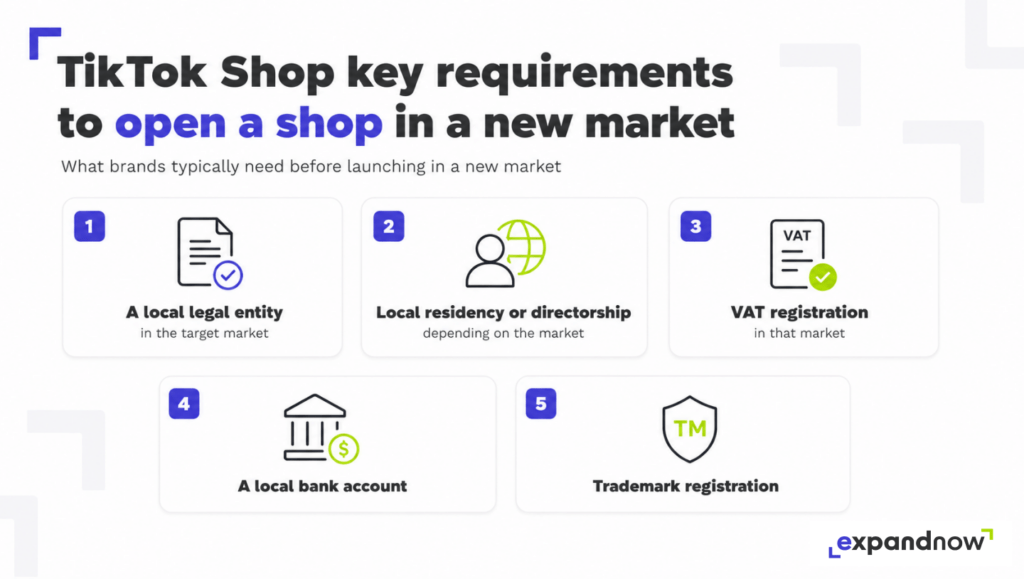
The hard gates, the things that must exist before a shop can be activated, are consistent:
There are a handful of additional requirements beyond these, but this is the set that determines whether a brand can open a shop at all. Have them, and the application proceeds. Miss one, and it does not.
Brands consistently underestimate how long this takes, and they underestimate it in a specific way. They budget for the administrative steps and forget the internal ones.
Establishing an entity varies in cost and timeline by market. Some markets require boots on the ground, meaning people actually employed by the company in order to register the business or obtain a VAT number. In markets that require a local director with local ownership, a brand may need to hire a full-time, director-level employee who can open and access a bank account. That is a permanent headcount decision made in service of a sales channel that has not yet generated revenue.
But the genuine bottleneck sits earlier. Seán described it as the long pole in the tent: every established brand has governance, and a new company breaks it. An additional entity means additional responsibility, additional research, additional legal advice, additional internal framework. Getting the organisation comfortable with opening a new company is frequently slower than opening it.
There is a sequencing problem on top of that. Most brands start one workstream at a time rather than running them in parallel, which extends an already long timeline. And all of it is paid for upfront, before a single unit is sold. Seán referenced advice, people, operations and technology costs that can run into six figures in a single market.
A Merchant of Record is a company that acts as the legal seller of your product in a market where you have no presence, taking on selling liability, VAT collection and remittance, and the payments and invoicing infrastructure that come with it.
In Seán’s framing, the definition matters less than the function:
“What a Merchant of Record really is, is a sales enabler.”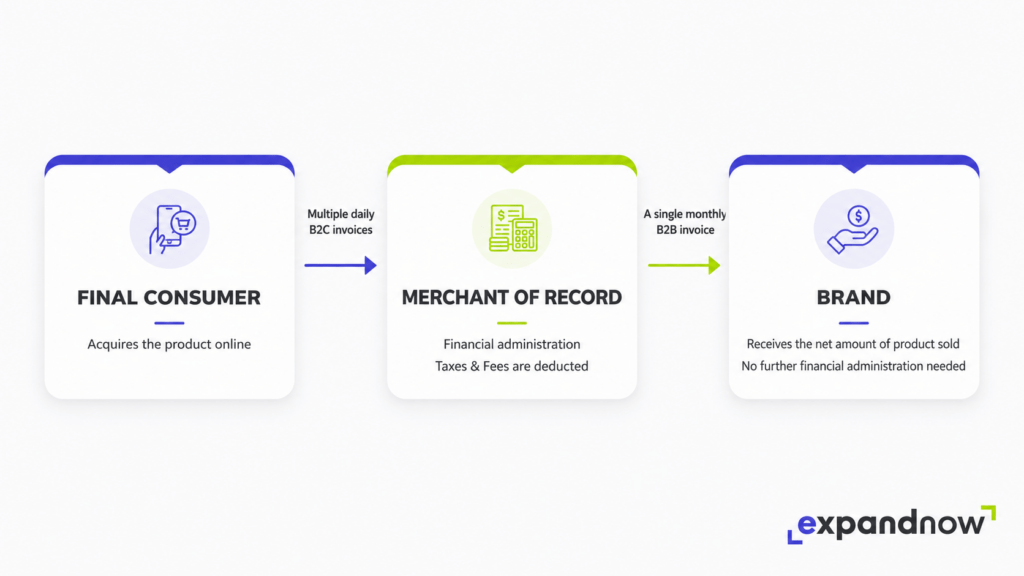
The problem it solves is always the same shape. A brand cannot reach a market, or cannot sell inside a specific channel, because it lacks the entity, the VAT number, the payments capability or the invoicing capability. The Merchant of Record supplies the missing layer so the brand can sell somewhere it could not sell yesterday, while keeping control of commerce.
This is not new. How the Merchant of Record model works originally existed to help brands that sell through resellers and retailers, in categories like consumer electronics and food, reach consumers directly for the first time. Those brands had no stores and no direct relationship with shoppers. Selling to a business that then sold to the consumer let them build a direct online presence without hiring teams, integrating technology or standing up daily operations in every market.
TikTok Shop simply made that same requirement mandatory rather than optional.
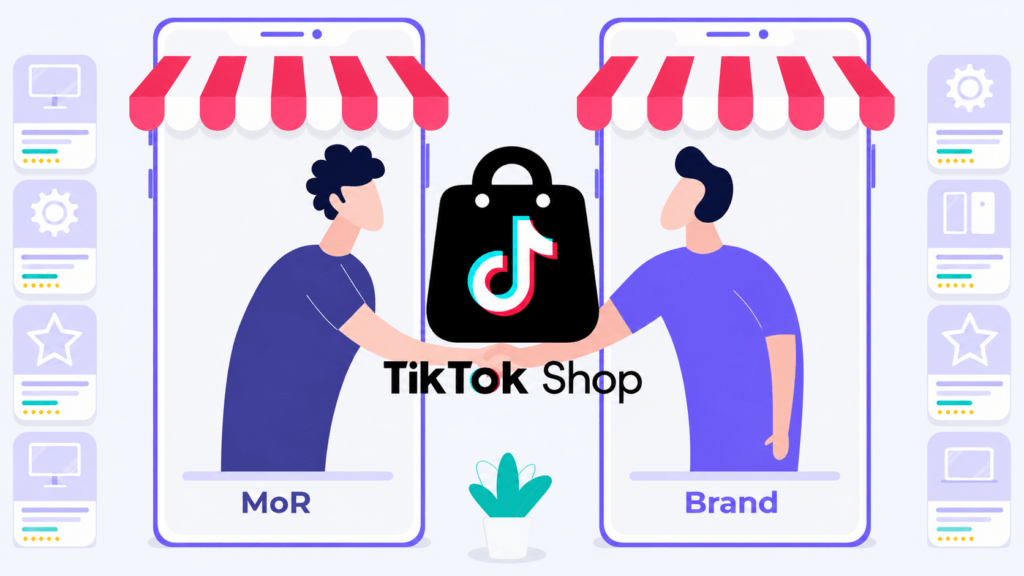
Once a brand accepts it needs a Merchant of Record, it discovers quickly that providers are not interchangeable. This is the part of the decision most brands rush, and it carries more risk than the entry decision itself.
The Merchant of Record assumes selling liability, which means the brand is no longer responsible for paying VAT. That is the point. But it is not a reason to stop paying attention. The relevant questions are operational: how reliably does this provider collect funds, remit VAT, reconcile the money and pay the brand?
Seán’s shortcut here is to look at who the provider works for and across how many channels. A provider operating across multiple channels and markets has built the muscle. A provider whose entire proposition is TikTok Shop may be responding to demand without fully understanding the obligations that come with it. Look behind the sales page and the website copy to understand who is actually behind the service.
This is the most practical due diligence question in the episode. Ask how the operation functions day to day. Are people sitting at desks moving money between bank accounts and assembling reports by hand, or is there a platform underpinning the services, the reporting and the movement of funds? The answer tells you whether obligations will be met repeatedly, or only when someone remembers.
This is the reason the checks matter. Your Merchant of Record owns your shop. If the provider is not fulfilling its obligations, it can be fined and shut down by the relevant authority, and it can run out of runway quickly. If that happens, the brand is stranded, without the shop and without the channel.
The most common assumption is that a brand with an audience will see organic sales arrive in volume. It rarely happens. TikTok Shop requires activating creators, both new and existing, and success on the channel depends on a deliberate affiliate or influencer strategy. Without one, brands leave most of the available upside on the table.
This one specifically affects brands expanding into new TikTok Shop countries, and it is the expensive version of the mistake. A brand that has succeeded in one market assumes the creators who drove that success will influence shoppers in the next one.
“TikTok is very localised. Local influencers are a key lever.”
Every new country requires the influencer strategy to be rebuilt locally, not translated.
Opening the shop is the beginning. Trading the channel is the work. Alongside creator strategy, most brands benefit from a specialist TikTok agency, because the settings inside the shop are genuinely nuanced. As Seán described it, the right configuration can make a shop very successful and the wrong one can bury it, which makes people who know those details worth their weight in gold.
The KPI that matters is whether TikTok justifies its function inside the business, and that question cannot always be answered inside the channel.
Some brands are profitable on TikTok Shop in isolation. Others deliberately are not, and are entirely comfortable with it. Seán described brands that lose money on the first purchase and keep pushing resource into the channel, because they have proven that the shopper replenishes within weeks, either back on TikTok organically or through a supermarket or reseller. Profit arrives on the second, third and fourth purchase, off-channel.
Both are valid strategies. What is not valid is not knowing which one you are running. That requires reporting that shows what TikTok Shop contributes after all deductions and all activity, on-channel and off-channel. Without it, brands are making resourcing decisions blind.
The reason the first market matters disproportionately is that it is the expensive one.
Once a brand is live and compliant in one TikTok Shop market through a Merchant of Record, the contract that enabled that shop can typically enable additional shops in other markets. In the episode, Seán put the timeline for opening a subsequent shop at around a week, against the six to twelve months a brand would face doing it alone. Just as importantly, the brand enters market two with data and internal capability it did not have in market one. This is the logic behind ExpandNow’s TikTok Shop solution.
ExpandNow’s recommendation is to hone the strategy in a single market first, then move to the next one, rather than opening several shops at once and diluting attention across all of them.
This is also where the Merchant of Record model has to keep evolving. Brands want to be omnichannel, and they want to be omnichannel outside their domestic market, where they are already compatible with every marketplace and direct-to-consumer channel. Meeting that means covering the meaningful marketplaces alongside direct-to-consumer and B2B, not just one channel well.
TikTok Shop international expansion is not a marketing decision with a compliance footnote attached. It is a compliance decision that determines whether the marketing is possible at all.
For a brand planning its next TikTok Shop market, three things follow from this:
TikTok does not always spell out the local entity and residency requirements clearly upfront, and many brands only discover them through a rejected application.
Compare the do-it-yourself route, with its upfront cost, permanent headcount and governance timeline, against the Merchant of Record route, where cost is linked to revenue rather than paid before launch.
The Merchant of Record owns your shop. Its operational health is your operational risk.
Seán’s closing advice was deliberately low-commitment: whether you are scaling into new TikTok Shop countries or getting rejected trying to enter for the first time, speak to a Merchant of Record before deciding anything. They will tell you the timeline, how pricing works, and how the two models compare for your specific business. That conversation is worth having before the six-month entity project starts, not after.
If you’re planning your next TikTok Shop market in Europe or the US, we’d be glad to walk you through what the entry requirements involve and how quickly you can be live. Get started now →
Have questions about expanding into TikTok Shop markets? Our TikTok Shop Guide has the answers you need.
